About procedure
DEEP PLANE Facelift
DEEP PLANE is a more advanced technique that goes deeper than the SMAS facelift. It targets the same SMAS layer but goes beneath it to reposition the entire composite of muscles, fat, and skin together. This technique involves:
Undermining beneath the SMAS: The surgeon works under the SMAS, releasing it from deeper attachments to the facial bones and muscles, allowing for more comprehensive repositioning of the facial anatomy.
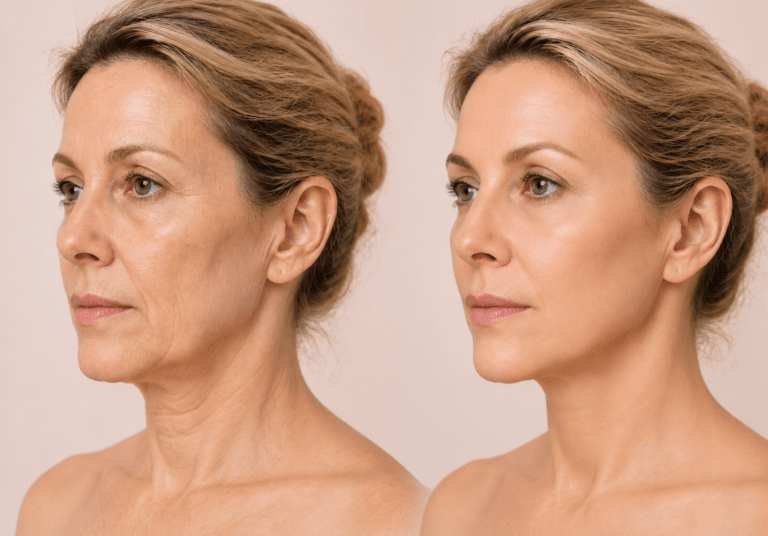
Benefits: This approach is particularly effective for patients with significant facial sagging and deeper wrinkles. It can achieve more dramatic and natural-looking results by allowing for more extensive manipulation and repositioning of the facial tissues. Surgeons also combine this procedure with a necklift, double chin liposuction or blepharoplasty (eyelid correction) to maximize the visual anti-aging effect.
Who is a good candidate for a DEEP PLANE facelift?
A DEEP PLANE facelift may be suitable for women and men who have moderate to significant signs of facial aging and are looking for a long-lasting, natural-looking rejuvenation rather than simply tightening the skin.
A good candidate typically has:
- moderate to significant sagging of the cheeks, jawline, or lower face,
- jowls and loss of jawline definition,
- deeper nasolabial folds and changes in the midface,
- loose skin and soft tissues around the face and, in some cases, the neck,
- good general health and realistic expectations about the outcome,
- sufficient skin elasticity and facial anatomy suitable for surgical repositioning.
There is no single ideal age for a DEEP PLANE facelift. Suitability depends more on facial anatomy, skin quality, tissue laxity, general health, and the patient’s goals than on age alone.
The final recommendation should always be made by an experienced plastic surgeon following an individual assessment.
When is a DEEP PLANE facelift not recommended?
As with any surgical procedure, a DEEP PLANE facelift is not suitable for everyone. Contraindications or factors requiring additional medical assessment may include:
- serious or poorly controlled medical conditions that increase the risks of surgery or anaesthesia,
- blood clotting disorders or medications that significantly affect blood clotting,
- active infection or inflammation in the treatment area,
- medical conditions that may significantly impair wound healing,
- uncontrolled high blood pressure,
- pregnancy or breastfeeding,
- unrealistic expectations or an inability to follow postoperative instructions.
Smoking and nicotine use are particularly important. Nicotine reduces blood flow to the tissues and can increase the risk of wound-healing problems and skin complications. Patients may therefore be required to stop smoking and using nicotine products for a specified period before and after surgery.
Some conditions or medications do not automatically exclude a patient from surgery but require individual evaluation by the surgeon and anaesthesiologist. Patients should always provide a complete medical history and disclose all medications and supplements before surgery.
How to choose a safe DEEP PLANE facelift surgeon abroad
A DEEP PLANE facelift is a technically demanding procedure. When considering surgery abroad, the experience of the surgeon and the safety standards of the clinic should be more important than price alone.
Before choosing your surgeon, check:
- Specialist qualification: The doctor should be appropriately qualified and recognised as a specialist in plastic surgery in the country where the procedure will take place.
- Specific facelift experience: Ask how frequently the surgeon performs facelifts and whether DEEP PLANE facelift surgery is a regular part of their practice.
- Before-and-after results: Review results from other patients, look for natural results rather than simply dramatic changes.
- Accredited or appropriately licensed clinic: The operation should take place in a healthcare facility authorised to perform surgical procedures and equipped for the planned type of anaesthesia.
- Pre-operative assessment: A responsible surgeon should review your medical history, medications, photographs and expectations and arrange the necessary pre-operative examinations.
- Aftercare: Make sure you know who will monitor your recovery, how postoperative checks are organised and whom to contact if a complication occurs after returning home.
- Transparent pricing: The quotation should clearly explain what is included, such as surgery, anaesthesia, hospital stay, postoperative checks and other related services.
Be cautious if a provider guarantees a particular cosmetic result, recommends surgery without an adequate medical assessment, cannot clearly document the surgeon’s qualifications, or puts pressure on you to book or pay immediately.
When travelling abroad for a DEEP PLANE facelift, good coordination between the patient, surgeon, clinic and medical travel provider is essential. At ROYAL MEDICAL, we work with selected surgeons and clinics in the Czech Republic and help international patients coordinate the assessment, treatment, stay and postoperative care.
What to expect?
Inpatient: 1 night
Anesthesia: general, analgosedation, local anaesthesia
Compressive headband: 1-2 weeks after the procedure
Light activity: 5 days
Full activity/sport activities: 2-4 weeks, according to healing and the surgeon’s instructions
Recovery varies from patient to patient. Swelling and bruising are expected after facelift surgery and may take several weeks to gradually subside.
Choosing between the two. The choice between a SMAS facelift and a DEEP PLANE facelift depends on the patient’s facial structure, the degree of aging and sagging, and the desired outcomes. It is also dependent on the surgeon’s expertise and comfort with each technique. The deep plane facelift requires more technical skill and experience due to the complexity of working beneath the SMAS layer.
Explore prices
After approval by a surgeon or doctor, we always present all inclusive rates with no hidden costs.
Doctors




The Way to Change Your Life Start Here
Our client service includes pre-departure consultations, on-site assistance and after care.
we will call you
proposal
your procedure
our pick up
your desires