



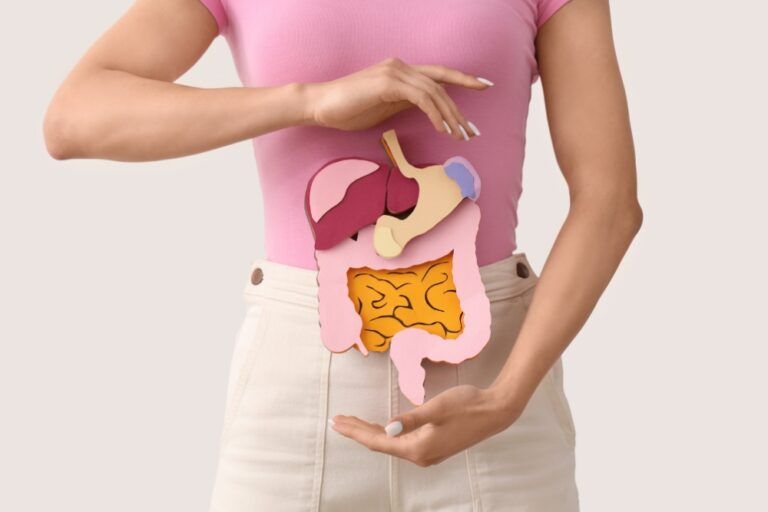

There is a type of body fat you cannot pinch, cannot see in the mirror and will not find on your bathroom scale. It sits deeper — wrapped around your liver, pancreas and intestines — and it is the fat doctors quietly worry about most. Last month we looked at what happens to your skin after rapid weight loss. This month we go one layer deeper.
What is visceral fat?
Visceral fat is body fat stored inside the abdominal cavity, packed around the internal organs. Unlike subcutaneous fat — the soft layer under the skin you can hold between two fingers — it cannot be felt from the outside. It is metabolically active tissue that drains fatty acids and inflammatory signals straight into the liver, contributing to insulin resistance, raised blood pressure and fatty liver disease.
Subcutaneous fat is storage. Visceral fat behaves like an organ — and not a well-behaved one.
You can be slim and still carry too much
An analysis of 259,388 people published in the Journal of the American College of Cardiology in August 2026 [2] found that 18% of participants with a completely normal BMI had elevated central fat that their weight never revealed. Among people living with obesity, central fat accounted for 49% of heart failure events and 36% of deaths from coronary heart disease.
BMI knows your weight and your height. It has no idea where the fat is.
The tape measure test
Stand up straight, find the top of your hip bone, bring the tape around at that level, breathe out normally — and do not hold your stomach in.
The American Heart Association’s 2026 [1] guidance flags abdominal obesity at 88 cm (35 in) or more for women and 102 cm (40 in) for men, with lower thresholds for people of Asian descent. Simpler still, NICE [3] recommends keeping your waist below half your height: at 170 cm tall, aim for under 85 cm. If the number worries you, we can help you understand the risks linked to a high BMI.
What actually works
Here is the good news: visceral fat is usually the first to go. The very thing that makes it dangerous — active tissue, constantly trading with the liver — is also what makes it responsive.
The changes that move it are unglamorous. Enough protein and fibre that meals actually keep you full. Fewer calories drunk rather than eaten, since sugary drinks and alcohol are the easiest win most people skip. Some resistance training, because muscle is where your body prefers to put glucose. A decent walk most days. And real sleep — five hours a night will quietly undo an otherwise sensible diet.
What will not move it: crunches, which strengthen the muscle beneath the fat without touching the fat itself, and liposuction, which works on the layer under the skin and cannot reach inside the abdominal cavity at all. Both are useful for shape. Neither changes your metabolic risk, and any clinic that suggests otherwise is not being straight with you.
Sometimes lifestyle change is not enough, particularly when obesity has been there for years. GLP-1 medication does reduce visceral fat as well as body weight, and bariatric surgery remains the most durable option we have: at ROYAL MEDICAL, gastric sleeve surgery starts from €6,550 for patients with a BMI above 35, with typical weight loss of 35–55% and two to three weeks of recovery. The gastric balloon is a gentler place to start. Which one suits you is next month’s article — sleeve versus GLP-1, side by side.
Key Takeaways
Visceral fat sits around the organs and cannot be pinched — it is metabolically active and drives cardiometabolic risk.
A normal BMI does not rule it out: 18% of normal-BMI adults in a 259,388-person study carried excess central fat.
Risk starts at a waist of 88 cm (women) or 102 cm (men), or a waist over half your height.
Liposuction does not remove visceral fat. Diet, strength training, sleep — and where needed GLP-1 or bariatric surgery — do.
Frequently Asked Questions
Can you have visceral fat with a normal BMI?
- Yes. Around 18% of normal-BMI participants in the 2026 JACC analysis had elevated central fat, which is why waist measurement adds information BMI cannot.
What waist measurement is considered risky?
- 88 cm (35 inches) or more in women and 102 cm (40 inches) or more in men, with lower thresholds for people of Asian descent — or any waist larger than half your height.
Does liposuction remove visceral fat?
- No. Liposuction removes subcutaneous fat from under the skin and cannot access the abdominal cavity, so it does not reduce metabolic risk.
How quickly can you lose visceral fat?
- It responds faster than subcutaneous fat — measurable reductions are common within eight to twelve weeks of consistent change, often before the scale moves much.
Sources
[1] American Heart Association, Measuring Waist Circumference for Comprehensive Health Assessment (Feb 2026) — https://professional.heart.org/en/-/media/PHD-Files/Education/CKMH-Obesity-Measuring-Waist-Circumference_030226.pdf
[2] Journal of the American College of Cardiology, Risk Reclassification Beyond BMI by Waist Circumference and Waist-to-Hip Ratio (11 Aug 2026) — https://www.jacc.org/doi/10.1016/j.jacc.2026.05.050
[3] NICE, Overweight and Obesity Management: Identifying and Assessing Central Adiposity (NG246) — https://www.nice.org.uk/guidance/ng246/chapter/Identifying-and-assessing-overweight-obesity-and-central-adiposity
This article is for information only and does not replace individual medical advice. Suitability for any procedure is always assessed by a doctor.